Monday, May 31, 2010

St. Roch (c.1295 to c.1327)


St. Francis of Assisi is the patron saint of animals but for all you canine lovers, St. Roch is the patron saint of dogs.
Also known as St. Rocco, he was born c.1295 in Montepelier, France. He made a pilgrimage to Rome, Italy to care for plague victims. He contracted the disease and survived.
St. Roch was imprisoned for five years as a spy and died there c.1327. After his death, miracle after miracle happened in his name, which led to a cult following. He is also the patron saint against the plague.

Sunday, May 30, 2010

St. Malo (c.520 to Nov. 15, 621)


As a kid, one of my favorite rerun episodes on the television series "Thriller" was the Remarkable Mrs. Hawk starring Jo Van Fleet and John Carradine. It was based on the Greek myth about the goddess Circe who turned men into pigs.
With my brothers, I memorized most of the lines and the story almost always came to mind whenever I saw a pig in a field or on a farm.
So, it's no wonder that as an adult living across the street from a woman who resides alone with a pig, Mrs. Hawk comes to mind. The most intriguing thing is that on any given day a different guy will go into her house, and I don't recall seeing him again.
"You've been bad today, Audrey," my neighbor often says to her pig as it strolls across the lawn. "There'll be no treats for you. Go back to your pen."
St. Malo, who was born in Wales c.520, is the patron saint of pig keepers. He was baptized by St. Brendan and is the founder of the walled city of Saint Malo, Brittany, France. St. Malo died on Nov. 15, 621 in Archambiac, France. His feast day is Nov. 15.

Saturday, May 29, 2010

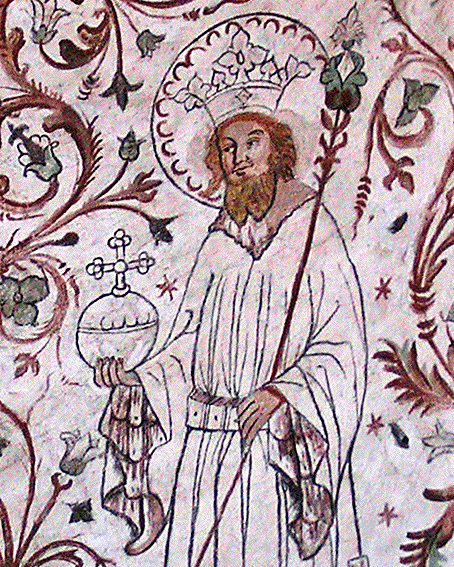
St. Eric IX of Sweden (? to May 18, 1160)


This afternoon, when I was at Christina's clothing store in Watch Hill, Rhode Island, I found a package of tiny wax soda bottles filled with juice. It was something I hadn't seen or tasted since I was a child. And, it made me just as excited as smelling the pomegranate perfume or checking out the Free People summer dresses.
So tonight, when I showed up at my brother and sister-in-law's house at 10 p.m., I was thrilled that my young nephews, Jack and Eric, were still awake. I played Wii with them then took out the wax soda bottles.
"How do I do this?" Eric asked.
I told him to pick a color (green) and then to bite the top off the bottle and drink. Down, it went. Then he had a yellow one and a red one. Jack drank a orange one and saved the blue one.
Next, Eric decided to make alphabet letters.
"What should I write?" the four-year-old asked. "I know how to spell things."
Today's saint is Eric IX of Sweden who wrote the Code of Uppland (Eric's Law). He helped to convert pagans and spread Christianity throughout Finland. St. Eric IX of Sweden's reign was 1155 to 1160 when he was beheaded near Uppsala on May 18.
His feast day is May 18.

Friday, May 28, 2010

St. Mariana de Jesus de Paredes (Oct. 31, 1618 to May 26, 1645)


One of my favorite things to do for fun was to have tarot or regular playing card readings with my cousin Cindy. The two of us would have them done with no expectations of an outcome and then we'd discuss what the readers said afterward.
"You're going to meet a man wearing a pinky ring," a psychic named Dorothy told Cindy.
The same woman described a guy I dated for 9 years, two days before I met him. She also warned me not to get back together with him during a year-long split.
"It's going to happen in April," Dorothy predicted. "Honey, please, whatever you do, don't get back with him."
And, as much as tarot reading is a form of entertainment for some or hope for others, I believe that the cards are just a prop put in front of someone. The accurate reader is intuitive. It's something that can't be explained.
Psychic hotlines are more popular than ever. But, it's nothing new. Centuries ago people were searching for just as many answers.
St. Mariana de Jesus de Paredes, who was bestowed with the gift of prayer, was born on Oct. 31, 1618 in Quito, Ecuador. She was a prophet who could foresee the future and was especially accurate at predicting matters of the heart.
St. Mariana de Jesus de Paredes was also able to cure diseases simply by making the sign of the Cross. She died on May 26, 1645. She is the patron saint of Ecuador and loss of parents. She is known as the Lily of Quito. Canonized: 1950.
Her feast day is May 28.

Thursday, May 27, 2010

St. John Cantius (June 23, 1390 to Dec. 24, 1473)


Film as Literature was the one class I looked forward to during my freshman year in college. "Stagecoach," "Carnal Knowledge," "Bullitt," "Cabaret," "Shampoo," and "Don't Look Now." The list goes on.
My Monday morning routine was as follows: U.S. History to 1877 from 8 to 9 a.m., go home and take a nap until 1 p.m., then go back to the college to watch a film at 2 p.m.
The class met two other times during the week which was usually when we'd take a test. On those days, I'd go to Burger King at the Lincoln Mall for lunch and down a Big Mac with a large order of fries and a diet Coke. I'm still thin but back then I was 92 lbs. On days when I was super hungry, I'd have two Big Macs.
My major was English and I loved the comfort of the film and writing classes which were taught by my all-time favorite college professor, Mr. Sullivan. His day off was Tuesday and he would go to the Showcase Cinemas in Seekonk, Mass. and see a first-run movie like "An Officer and A Gentlemen."
He loved writing poetry and on the day he dedicated a poem to me it was so racy I had to put my head down in embarrassment.
I took several semesters of classes with Mr. Sullivan (including Film as Literature II and II), where I excelled with straight A's, then transferred to Emerson College in Boston to study print journalism. It was a new major at the time with less than 10 students. I never forgot Mr. Sullivan's words of encouragement and his enthusiasm for my writing.
He was so in tune with things that he advised me not to marry my now ex-husband.
"You're too smart and too pretty, Marilyn. It will never last." he said. How did he know what my future held?
Right after I started this blog at the beginning of the year, I ran into Mr. Sullivan. So many years had passed, yet he remembered me.
"You look fantastic!" he said. "You still have that youthful energy."
A month or so later, Mr. Sullivan posted a comment on my blog telling me to keep up the good work. It made me feel so good to be reunited with my favorite college professor and to know that he would be following my writing.
But that all ended yesterday when Mr. Sullivan died. In his memory, I recognize the patron saint of professors, St. John Cantius. He was born on June 23, 1390 in Poland. He was a theologian and professor of Sacred Scriptures. He died on Dec. 24, 1473. Canonized: 1767. St. John Cantius's feast day is Dec. 23.

Wednesday, May 26, 2010

St. Joan of Arc (c. 1412 to May 30, 1431)


On a warm and sunny day last weekend, I decided to stay inside and see "Joan of Arc: An Opera in Three Acts" by my friend, Steve Jobe, at the Blackstone River Theatre
It was worthy of a much bigger venue like the Providence Performing Arts Center.
In the program Steve wrote, "While I do not claim to understand the nature of her visions, it's clear that for a while, they were such that Joan enjoyed unprecedented success in the quest to liberate France near the end of the 100 Years War. But as we know too well in the present day, 'things fall apart.' and in most ways they did, tragically for Joan."
St. Joan of Arc was born in Domremy, France c.1412. No matter what your religion, most people are familiar with her story or have at least heard her name. She was a peasant girl responsible for many victories of the French Army and the coronation of King Charles VII.
St. Joan of Arc claimed she had visions of God telling her to save France from the British. She was burned at the stake at age 19 on May 30, 1431. Canonized: 1920. Her feast day is May 30 and she is the patron saint of France, martyrs, and militants.

Tuesday, May 25, 2010

Dedication of the Basilica of St. Francis of Assisi


"We praise You, Lord, for Sister Moon and the stars, in the heavens you have made them bright, precious and fair." (St. Francis of Assisi)

I just learned of the passing of Friar Kevin Kenny, OFM Conv., who was the director of the National Shrine of Blessed Kateri Tekakwitha in Fonda, New York. I met him at the there in August 2004 and kept in touch for several years. Friar Kenny was a member of the Convectual Franciscans, an order of friars founded by St. Francis of Assisi in 1209.
My experiences in Assisi were life altering. May 24 is the Feast of the Dedication of the Basilica of St. Francis of Assisi.
When St. Francis died in October 1226, he was buried at St. George Church in the medieval town. It is now St. Clare of Assisi Chapel.
In 1230, his body was brought to a new church, and 23-years-later, Pope Innocent IV consecrated the Church of San Francesco which was later named a papal chapel and patriarchal basilica.

Monday, May 24, 2010

St. Teresa of the Andes (July 13, 1900 to April 12, 1920)


A young girl I knew passed away yesterday. She was a college student who was diagnosed with a brain tumor last year. She was an artist and aspiring jewelry maker.
When you hear about a young person dying, it stops you in your tracks and, for a moment, you put life into perspective. Why did someone with a life full of promise die?
St. Teresa of the Andes is a patron saint of young people. She was born on July 13, 1900 in Santiago, Chile. St. Teresa of the Andes was a Discalced Carmelite novice who died at just 19-years-old on April 12, 1920 in Los Andes, Chile. Canonized: 1993. Her feast day is April 12.

Sunday, May 23, 2010

St. Barbara (? to Dec. 4, 306)


I grew up watching the sparkle of fireflies on warm June evenings in my yard. I'd run around in my shorts after my parents sprayed me with insect repellent and I'd get to play outside after dinner until it was time to go for ice cream.
Some nights my dad would help me catch fireflies and we'd put them in a jar. Then, I'd have to release them before going inside. One of the most exciting times was when one found its way into my bedroom. I fell asleep to its magical flicker.
Today, I read an essay by a woman who saw fireflies for the first time as an adult living in Florence, Italy. The native Californian likened them to Christmas lights and "heaven right here on Earth." She also spoke of June in Florence and celebrations with fireworks.
St. Barbara, the patron saint of fireworks. She was born in Nicomedia in the third century. Her pagan father locked her in a tower to keep her chaste. While she was in seclusion she became a Christian and refused a marriage propoal. When St. Barbara's father found out she was a Christian, he beheaded her on Dec. 4, 305.
For his wrongdoing, he was struck by lightning and died. St. Barbara is also the patron saint against lightning. Her feast day is Dec. 4.

Saturday, May 22, 2010

St. Ambrose (339 to April 4, 397)


I believe in power of candles. Green is for money or abundance. Pink is love. Red is seduction or passion. The list goes on.
Whenever my friend, Kristen, was going to pay bills, she'd light her happy home candle and she and her boyfriend, Dave, would never fight. It was an orange candle.
"It's amazing," she'd say to me. "It really works."
Kristen and I would stock up on Crystal Journey herbal magic candles. White Light Books and Grateful Heart were where we'd buy them in Rhode Island. And, although they come with an "anointment" prayer, we'd also say whatever we felt and it still worked.
Kristen and Dave became husband and wife at a National Park in Alberta, Canada, and they are still happily married (thanks, in part, to the candles)!
It doesn't matter what brand of candles you use. What matters is that you believe. Because they do work. I always have candles burning in my home. The flicker is peaceful and it's a good form of meditation. Just remember to trim the wick each time you use one and blow it out when you leave the house or go to sleep.
St. Ambrose is the patron saint of candlemakers. He was born in Trier, Germany in 339. He became a bishop of Milan, Italy and is the first doctor of the Roman Catholic Church. St. Ambrose died on April 4, 397. His feast day is December 7.